Selling your car to a salvage yard in Indianapolis is a four-step process: get a quote, schedule pickup, hand over the title, get paid. At a full-service yard like The New Country Auto Parts on Stanley Avenue, every car is evaluated for parts demand and condition — not just scrap weight. That is why a full-service yard usually pays more than a scrap-only buyer for the same vehicle.
Last updated: May 2026

Most articles about selling to a salvage yard read like a sales pitch. This one is written from the other side of the counter. We run a full-service yard in Indianapolis, we buy cars every week through our sister brand Cash Car Heroes, and we know exactly how the math works — because we are the ones doing it.
This guide walks through what actually happens when a car gets sold to a yard. How the offer is built, what a yard looks for, what happens to the vehicle after the sale, and where TNCAP sits in the Indianapolis salvage market.
How to Sell a Car to a Salvage Yard in Indianapolis
The process from the seller’s side is simple. From the yard’s side, every step has a purpose.
- You request a quote. Call, text, or submit a form with the year, make, model, condition, and whether the vehicle runs. At Cash Car Heroes, you get an offer within 10-15 minutes during business hours.
- The yard makes an offer. The number is built from three things: parts demand for that vehicle, its condition, and the day's scrap metal market. More on each below.
- You accept and schedule pickup. Free towing is standard for any vehicle in the Indianapolis metro. You do not need to be home if the keys, title, and vehicle are accessible.
- You hand over the title, get paid on the spot. Indiana requires a clean title in your name to transfer ownership. Payment is cash or check at pickup — never deducted for towing.
The whole process from first call to vehicle gone can take less than 24 hours. Most accepted offers in central Indiana get picked up the same day.
What happens next is the part most sellers never see — and it is where the real value is. Once the vehicle reaches the yard at 3013 Stanley Avenue, it gets weighed, drained, and triaged. Fluids and hazardous materials come out first: motor oil, coolant, transmission fluid, brake fluid, and gasoline are all captured and recycled. Freon is recovered with EPA-certified equipment per EPA Section 608. Mercury switches come out. Tires are pulled and routed to a separate recycler. Only then does the vehicle enter the yard.
Full-Service vs. Self-Service Salvage Yards
This is the single biggest decision when picking a yard to sell to — and it usually decides how much you get paid.
A full-service yard like TNCAP has parts-pullers on staff. We have the equipment, the experience, and the inventory system to extract every saleable part from a car — engines, transmissions, alternators, wheels, body panels, electronics, seats, the whole list. Those parts are sold one-by-one to mechanics, body shops, and DIYers across central Indiana, often for many times more than the metal alone is worth.
A self-service yard (also called a U-Pull or pick-a-part yard) brings vehicles in, sets them on blocks, and lets customers pull their own parts. It is cheaper for the buyer but generates less revenue per vehicle for the yard — which means lower offers for the seller. Pull-A-Part on Producers Lane and Indy U-Pull-It on West 16th Street are the well-known self-service options in Indianapolis.
The math is straightforward: a yard that can sell your old transmission for $500 retail can pay you more for the whole car than a yard that only sells it as bulk scrap. That is the core reason TNCAP — a full-service yard with our own parts inventory and 30-day warranty on every part sold — typically pays more than scrap-only buyers for the same vehicle.
| Full-Service Yard (TNCAP) | Self-Service Yard | Scrap-Only Buyer | |
|---|---|---|---|
| Who pulls the parts | Yard staff | Customer | Nobody — crushed whole |
| Revenue per car | Highest | Mid | Lowest |
| Typical seller payout | Best | Mid | Lowest (scrap weight only) |
| Free pickup | Yes | Varies | Often no |
| Title required | Yes | Yes | Sometimes flexible |
Wondering what your car is worth in 2026? Our sister brand Cash Car Heroes handles the buy side of the TNCAP ecosystem — free quote in 10-15 minutes, free towing, cash on the spot. Get a free offer →
What a Salvage Yard Actually Looks for in Your Car
When a vehicle hits the lot, the appraisal is not guesswork. The yard is checking specific things, and each one moves the offer up or down.
1. Parts demand for the make and model
The single biggest factor. A 2008 Honda Civic with rust holes pays well because every part on it is in constant demand across Indianapolis. A 2003 Saturn Ion with the same condition pays less — there is no parts market for it. Common, popular vehicles win. Domestic trucks (F-150, Silverado, Ram), Honda and Toyota sedans, and Jeep Wranglers consistently top the offer ranges. For a complete breakdown of how much junkyards pay for cars, we have a dedicated guide.
2. Inventory gaps at this specific yard
This one is invisible to outside calculators. If a yard already has six Honda Accords in inventory, the seventh is worth less. If a yard has zero Dodge Caravans and a body shop has been calling weekly for a Caravan door, that incoming Caravan can command a premium. Inventory is local. It is also why two yards can quote the same vehicle very differently on the same day.
3. Running vs. not running
A vehicle that starts and drives is worth substantially more than the identical model that will not turn over. Why? Because a running engine and transmission can be tested, photographed, and sold as known-good. A dead car forces the yard to either part out blind or sell the engine as core. The price gap is often $200-$500 on the same model.
4. Body and parts integrity
The yard checks what is still on the vehicle. Catalytic converter still installed? Adds value. Aluminum wheels still mounted? Adds value. Body panels straight and not creased through? Adds value. Stripped vehicles — where the converter and parts are already missing — get scrap-weight offers.
5. Title status
Indiana requires a clean title in your name to legally transfer a vehicle (Indiana BMV). A salvage yard cannot legally take a vehicle without proof of ownership. Missing-title situations are workable case-by-case (duplicate title from the BMV, or a Certificate of Authority — here’s how both work), but it slows the process. Have the title ready and the sale closes that day.
What Happens to Your Car After You Sell It
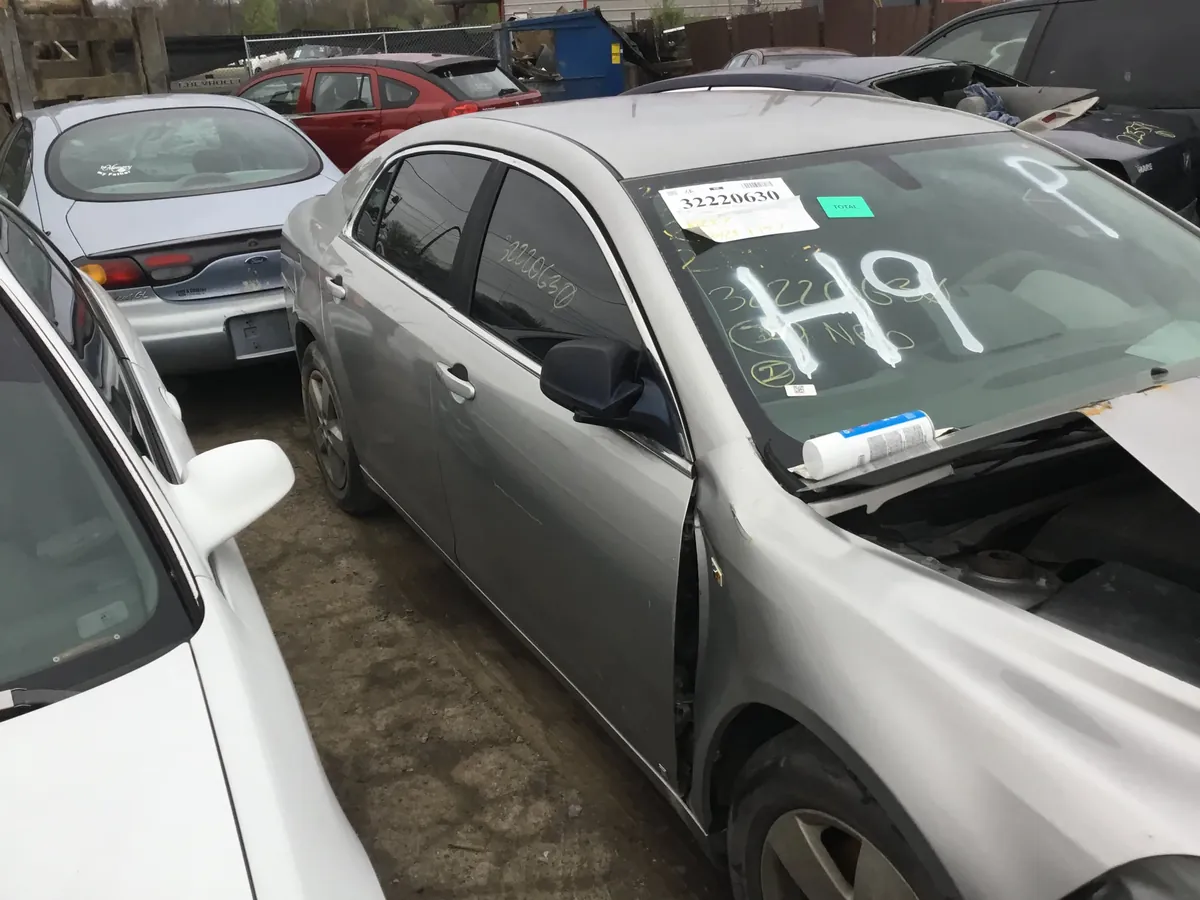
The vehicle does not get crushed and forgotten. At a full-service yard, the lifecycle is closer to a careful dismantle than a junk pile.
- Fluids and hazmat removed. Drained, separated, and routed to recyclers. Nothing soaks into the ground.
- Tires pulled and recycled. Indiana regulates tire disposal; they go to processors that grind them for road base and crumb rubber.
- Wheels pulled. Saleable wheels at TNCAP are routed to our sister business Papa Wheelies and resold as used OEM.
- Catalytic converter removed. This is one of the highest-value individual parts on any modern car.
- Engine, transmission, and major components tagged and inventoried. If the engine ran, it gets photographed, tested, and listed.
- Body parts cataloged. Doors, fenders, hoods, mirrors, lights, glass, interior panels, and seats all go on the parts shelf.
- Vehicle parked in the yard by make and model. This is where customers come in to pull their own parts at a discount, or to have our staff pull parts for them.
- Final shell sent to a scrap steel mill. What is left after months of part sales becomes raw material for new steel.
This is what auto recycling actually looks like. Cars are among the most recycled products on earth — the Automotive Recyclers Association reports that roughly 86% of a vehicle’s material content is ultimately recycled, reused, or recovered, and more than 12 million vehicles a year are processed through professional yards across the U.S. and Canada.

Selling Your Car to The New Country Auto Parts
If you want to sell your vehicle through the TNCAP ecosystem, the path is:
- Get a quote through Cash Car Heroes — our buying arm handles the offer. Quotes typically come back within 10-15 minutes during the day.
- Accept the offer and we schedule pickup. Free towing is included for vehicles across the Indianapolis metro and Central Indiana service area.
- Hand over the keys and a clean Indiana title. Payment is cash or check on the spot. No towing deduction.
- The vehicle comes to 3013 Stanley Avenue. From there it enters the full TNCAP intake process described above — fluids out, parts cataloged, eventually inventoried and resold piece by piece.
TNCAP is open Monday-Friday 8 AM to 5 PM and Saturday 9 AM to 2 PM. We are licensed, bonded, and insured, and have served Central Indiana from this location since 2015. The yard is at 3013 Stanley Avenue on the south side of Indianapolis — you can plan a visit if you want to see the operation, or sell directly through Cash Car Heroes if you just want the car gone.
Ready to sell? The TNCAP family of brands buys cars in any condition across Central Indiana. Free quote in 10-15 minutes. Cash on the spot. Free towing always included. Start your free quote →
Frequently Asked Questions
How does selling a car to a salvage yard work?
You get a quote based on your vehicle’s year, make, model, and condition, accept the offer, and the yard arranges pickup — usually with free towing. You hand over a clean title at pickup and receive payment on the spot. The whole process can take less than 24 hours from first call to vehicle gone, especially in the Indianapolis metro.
How long does it take to sell a car to a salvage yard?
At Cash Car Heroes and TNCAP, the quote comes back in 10-15 minutes during business hours. Most accepted offers in Central Indiana are picked up the same day. From your first call to cash in hand can easily be under four hours if the title is ready and you live within the core service area.
Do I need a title to sell my car to a salvage yard in Indiana?
Yes. Indiana requires a clean title in your name to legally transfer a vehicle. If your title is lost or damaged, you can request a duplicate from the Indiana BMV. For older vehicles or missing-title situations, some yards work with a Certificate of Authority on a case-by-case basis. Have the title ready and the sale closes faster.
Do salvage yards take cars that do not run?
Yes. Most salvage yards take non-running vehicles — this is in fact most of the inventory. The vehicle does not need to start, drive, or even have all four wheels. It does need to be reasonably complete and have a title. Non-running cars typically pay less than running ones because the engine and transmission cannot be tested and sold as known-good, but they still have real value in parts and scrap.
What is the difference between a full-service and self-service salvage yard?
A full-service yard has staff pull parts for customers and sells the whole catalog from inventory. A self-service yard sets vehicles on blocks and lets customers pull their own parts at a lower price. The difference matters when you are selling: full-service yards can extract more value per vehicle and usually pay more for incoming cars. TNCAP is a full-service yard.
How much will a salvage yard pay for my car?
Most junk cars in the Indianapolis area sell for $100 to $1,500, depending on the vehicle’s year, make, model, weight, condition, and parts demand. Heavier trucks and popular makes bring the high end. Stripped or non-running compacts sit at the bottom. Our junkyard pricing guide breaks down the math.
What happens to my car after I sell it to a salvage yard?
Fluids and hazardous materials are drained and recycled. Tires and wheels are pulled. The catalytic converter is removed. The engine and transmission are tested and inventoried if running. Doors, panels, lights, mirrors, and interior parts are cataloged and shelved. The vehicle is parked in the yard by make and model. As parts sell out over months, the remaining shell goes to a steel mill. Cars are among the most recycled products on earth.